Sunday, September 18, 2022

What distinguishes LPG from other members of the family of petroleum hydrocarbons is.. Part 4

 Diesel


Types of Hydrocarbons in Diesel:

Unlike gas fossil fuels that are composed primarily of a single hydrocarbon isomer type, liquid fossil fuels like gasoline, kerosene (jet fuel, diesel),  are a compilation of hydrocarbon isomers. They are melodies of more than one hydrocarbon isomer type. 

Of the fossil fuels, diesel has one of the highest energy densities. “The average chemical formula for common diesel fuel is C12H24, ranging approximately from C10H20 to C15H28.” That means diesel has a carbon-to-hydrogen ratio of 1-to-2 or greater. 

There is a direct correlation between the carbon to hydrogen ratio and fuel density. There is a direct correlation between the size of molecule chains in a fuel and fuel density. So, while there is a strict definition of fuel density, a simple explanation of fuel density is the size of the hydrocarbon molecules in a fuel in conjunction with the carbon-to-hydrogen ratio. 

The carbon to hydrogen ratio of diesel — the fuel density — is significantly higher than all gas fossil fuels as well as liquid fossil fuels. Only the highest quality coal in the world, anthracite, has an energy density that exceeds that of diesel. 

Friday, September 9, 2022

What distinguishes LPG from other members of the family of petroleum hydrocarbons is.. Part 3

                                   Kerosene


Kerosene oil is a flammable liquid which is used in many industries and homes around the world as a fuel for light, heat and power. It is generally non-viscous and clear, however viscous substances such as wax and other thicker substances can be made from kerosene.


The chemical composition of kerosene is fairly complex, and it is a complex mixture of paraffins (55.2%), naphthene's (40.9%), and aromatic hydrocarbons (3.9%). Kerosene tends to contain hydrocarbons that have anywhere from 11 to 13 carbons in the chains. Liquid kerosene fuels contain potentially harmful compounds, including hexane and benzene.


Kerosene is widely used to power jet engines of aircraft (jet fuel), as well as some rocket engines in a highly refined form called RP-1. It is also commonly used as a cooking and lighting fuel, and for fire toys such as poi. In parts of Asia, kerosene is sometimes used as fuel for small outboard motors or even motorcycles.


In developing countries, the widespread use of kerosene comes with numerous different issues. Hazards of kerosene use include poisoning, fires, and explosions. As well, some kerosene lamps emit fine particulates, carbon monoxide, nitric oxides (NOx), and sulfur dioxide when burned. These by-products may reduce lung function and increase risks of asthma and cancer. Taking into account the risks of using kerosene, cleaner alternatives to kerosene technologies for lighting and cooking should be investigated - although kerosene is still a safer option in many cases than using solid fuels.

Wednesday, September 7, 2022

What distinguishes LPG from other members of the family of petroleum hydrocarbons is.. Part 2

               Boiling (or vaporization)Gasoline


Gasoline, kerosene, diesel oil and other similar hydrocarbons are normally liquids at atmospheric pressure and temperature. To make them boil and vaporize requires the application of considerable heat.

                                                                 Gasoline:

Gasoline is a hydrocarbon. When you put gas in your car, the gas enters the combustion chamber and is combined with air. The air molecule will collide with the gasoline molecule, causing it to split into one hydrogen atom and one carbon atom. The combination of these two elements creates water vapor, which has a much lower boiling point than gasoline so it quickly evaporates.

Rudolf Diesel 


Rudolf Diesel invented the compression ignition engine in 1897. Shortly thereafter, advances in the refining industry produced gasoline. But not in its modern form. Back then, gasoline was basically a derivative of kerosene, a waste byproduct of early oil refining. It was considered a nuisance and was disposed of by being dumped onto the ground or into rivers.

Soon, however, inventors recognized that gasoline's high energy potential made it an ideal fuel, something that could advance engine development. There was a problem, though: Gasoline does not burn in liquid form. It needs to be atomized, emulsified and vaporized to ignite. This means it must be broken down into small particles, be mixed with air, and undergo a phase change through heat. The carburetor's job is to accomplish the first two steps, while a process called the latent heat of vaporization takes credit for the last step.

One property of gasoline is that the more heat it is exposed to, the more volatile its vapors become. In order to use gasoline as a fuel for an internal combustion engine, something had to heat it, forcing it into a vapor phase. That something is the carburetor.

Gasoline vaporizes at 140 degrees.
The fumes are capable of ignition up to12 feet away from a pooled source. It can float on water and may spread long distances, making ignition and flash back possible. Gasoline may ignite from a nearby spark, flame, or even static electricity.


Thursday, September 1, 2022

What distinguishes LPG from other members of the family of petroleum hydrocarbons - Part 1

                     Liquified Petroleum Gas


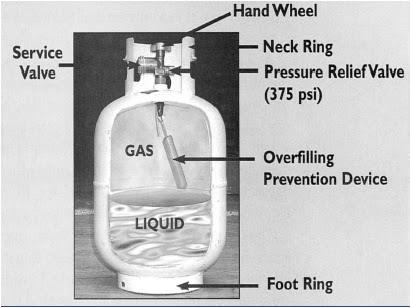
 LPG: is a petroleum hydrocarbon which is a liquid when stored under moderate pressures and a gas when released at normal ambient temperatures. It is inherently safe, and is generally only dangerous if it is escaping. Its vapor pressure increases rapidly as the temperature increases. When the gas is released to atmosphere at ordinary temperatures, it expands rapidly.


It is heavier than air and care needs to be taken not to allow leaks where significant amounts of gas is going to accumulate. Within the flammable limits of LP-gases, a single spark can easily ignite the product. Because it is odourless, approved odorants must be added. Finally, LP-gases are considered non-toxic. However, in confined spaces LP-gases can displace oxygen. Due to decreased levels of oxygen, this condition can cause unconsciousness or death.     


Wednesday, August 24, 2022

The Physical Laws Relating to Gas. Charles’s Law - Part 3

 This law is named after Jacques Charles (1746–1823), a French physicist who discovered that all

gases increase in volume by the same proportion if heated through the same temperature range, provided

that the pressure remained constant. This proportion is 1/273 of their volume at freezing point

(0◦C or 273K) for each 1K rise above 273K. Therefore, the temperature of a volume of gas would

need to be increased from 0◦C to 273◦C in order to double its volume. (Note: 1K rise = 1◦C rise.) 


Where the pressure remains constant, Charles’s law is expressed as:

                                                           Volume ÷ Temperature = Constant

In simple terms, if the temperature increases, so does the volume. As with Boyle’s law, the formula

can be redefined as:

                                                                   V1 ÷ T1 = V2 ÷ T2

Where V1 = original volume, T1 = original temperature, V2 = final volume and T2 = final temperature.

Practical example If 1 m3 of gas enters a building from outside where the temperature is 2◦C and

passes into a building where the temperature is 21◦C, the gas would increase in volume by:

                                                    V1 ÷ T1 = V2 ÷ T2, so (V1 × T2) ÷ T1 = V2

                                          ∴ 1 × (21 + 273) ÷ (2 + 273) = 1.07 m3, an increase of 7%


The Physical Laws Relating to Gas. Boyle’s Law - Part 2


This law is named after Robert Boyle (1627–1691), who discovered the relationship between volume

and pressure of a gas. He found that the absolute pressure of a given mass of gas is inversely

proportional to its volume provided that its temperature remains constant (Absolute pressure =

Atmospheric pressure (1013 mbar + gauge pressure). 


                                                                             So.....


To put it simply, if the absolute pressure (gauge pressure + atmospheric pressure) on a given quantity

of gas decreases, then its volume will increase. So if the absolute pressure is increased four-fold, the

volume would be reduced to one quarter. The formula can be redefined as:

                                                                    P1V1 = P2V2

Where P1 = original pressure, V1 = original volume, P2 = final pressure and V2 = final volume.


Practical example Suppose that the supply pressure to a building is 80 mbar and the total volume

is 1 m3, if the pressure was reduced to 20 mbar the new volume of the gas would be calculated as

follows.

                                                  P1V1 = P2V2, so P1V1 ÷ P2 = V2

                           ∴ (1013 + 80) × 1 ÷ (1013 + 20) = 1.06m3an increase of6%.

Conversely, if the supply pressure is increased to 800 mbar when a new medium pressure regulator

is fitted, supplying the same 1 m3 volume of gas, and also reduced to 20 mbar, there is an interesting

result:

                                                                   P1V1 ÷ P2 = V2

                                ∴ (1013 + 800) × 1 ÷ (1013 + 20) = 1.76m3, an increase of76%

This increase is probably the reason that the gas supplier installed the regulator prior to the meter.


The Physical Laws Relating to Gas. Graham's Law of Diffusion - Part 1

                                                            Graham’s Law of Diffusion


This law is named after Thomas Graham (1805–1869), who discovered that gases will mix with one another quite readily due to the continuous movement of the molecules. However, the rate at which they mix depends on the specific gravity or density of the gases. Graham made a container, consisting of two separate compartments with a small hole in their dividing wall. He placed a different gas in each of the compartments, one having a higher specific gravity than the other. He found that more faster, lighter molecules of the lighter gas passed through the hole rather than the slower, heavier molecules of the heavier gas. After many experiments he discovered that the rates of diffusion, or mixing, varied inversely to the square root of the density of the gas. Thus:

Diffusion rate ∝ 1 ÷

Density

Which basically means that a light gas will diffuse twice as fast as a gas four times its density.


Hobs - Did you know?

T he hob is used for boiling, frying, steaming, simmering and braising. I t  primarily works by the conduction of heat from the flame throug...