Friday, September 9, 2022
What distinguishes LPG from other members of the family of petroleum hydrocarbons is.. Part 3
Wednesday, September 7, 2022
What distinguishes LPG from other members of the family of petroleum hydrocarbons is.. Part 2
Boiling (or vaporization)Gasoline
Gasoline:
![]() |
| Rudolf Diesel |
Thursday, September 1, 2022
What distinguishes LPG from other members of the family of petroleum hydrocarbons - Part 1
Liquified Petroleum Gas
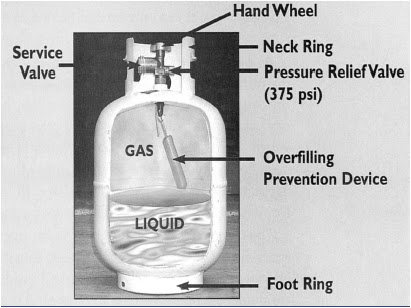
LPG: is a petroleum hydrocarbon which is a liquid when stored under moderate pressures and a gas when released at normal ambient temperatures. It is inherently safe, and is generally only dangerous if it is escaping. Its vapor pressure increases rapidly as the temperature increases. When the gas is released to atmosphere at ordinary temperatures, it expands rapidly.
It is heavier than air and care needs to be taken not to allow leaks where significant amounts of gas is going to accumulate. Within the flammable limits of LP-gases, a single spark can easily ignite the product. Because it is odourless, approved odorants must be added. Finally, LP-gases are considered non-toxic. However, in confined spaces LP-gases can displace oxygen. Due to decreased levels of oxygen, this condition can cause unconsciousness or death.
Wednesday, August 24, 2022
The Physical Laws Relating to Gas. Charles’s Law - Part 3
This law is named after Jacques Charles (1746–1823), a French physicist who discovered that all
gases increase in volume by the same proportion if heated through the same temperature range, provided
that the pressure remained constant. This proportion is 1/273 of their volume at freezing point
(0◦C or 273K) for each 1K rise above 273K. Therefore, the temperature of a volume of gas would
need to be increased from 0◦C to 273◦C in order to double its volume. (Note: 1K rise = 1◦C rise.)
Where the pressure remains constant, Charles’s law is expressed as:
Volume ÷ Temperature = Constant
In simple terms, if the temperature increases, so does the volume. As with Boyle’s law, the formula
can be redefined as:
V1 ÷ T1 = V2 ÷ T2
Where V1 = original volume, T1 = original temperature, V2 = final volume and T2 = final temperature.
Practical example If 1 m3 of gas enters a building from outside where the temperature is 2◦C and
passes into a building where the temperature is 21◦C, the gas would increase in volume by:
V1 ÷ T1 = V2 ÷ T2, so (V1 × T2) ÷ T1 = V2
∴ 1 × (21 + 273) ÷ (2 + 273) = 1.07 m3, an increase of 7%
The Physical Laws Relating to Gas. Boyle’s Law - Part 2
This law is named after Robert Boyle (1627–1691), who discovered the relationship between volume
and pressure of a gas. He found that the absolute pressure of a given mass of gas is inversely
proportional to its volume provided that its temperature remains constant (Absolute pressure =
Atmospheric pressure (1013 mbar + gauge pressure).
So.....
To put it simply, if the absolute pressure (gauge pressure + atmospheric pressure) on a given quantity
of gas decreases, then its volume will increase. So if the absolute pressure is increased four-fold, the
volume would be reduced to one quarter. The formula can be redefined as:
P1V1 = P2V2
Where P1 = original pressure, V1 = original volume, P2 = final pressure and V2 = final volume.
Practical example Suppose that the supply pressure to a building is 80 mbar and the total volume
is 1 m3, if the pressure was reduced to 20 mbar the new volume of the gas would be calculated as
follows.
P1V1 = P2V2, so P1V1 ÷ P2 = V2
∴ (1013 + 80) × 1 ÷ (1013 + 20) = 1.06m3an increase of6%.
Conversely, if the supply pressure is increased to 800 mbar when a new medium pressure regulator
is fitted, supplying the same 1 m3 volume of gas, and also reduced to 20 mbar, there is an interesting
result:
P1V1 ÷ P2 = V2
∴ (1013 + 800) × 1 ÷ (1013 + 20) = 1.76m3, an increase of76%
This increase is probably the reason that the gas supplier installed the regulator prior to the meter.
The Physical Laws Relating to Gas. Graham's Law of Diffusion - Part 1
Graham’s Law of Diffusion
This law is named after Thomas Graham (1805–1869), who discovered that gases will mix with one another quite readily due to the continuous movement of the molecules. However, the rate at which they mix depends on the specific gravity or density of the gases. Graham made a container, consisting of two separate compartments with a small hole in their dividing wall. He placed a different gas in each of the compartments, one having a higher specific gravity than the other. He found that more faster, lighter molecules of the lighter gas passed through the hole rather than the slower, heavier molecules of the heavier gas. After many experiments he discovered that the rates of diffusion, or mixing, varied inversely to the square root of the density of the gas. Thus:Diffusion rate ∝ 1 ÷
√
Density
Which basically means that a light gas will diffuse twice as fast as a gas four times its density.
Thursday, July 7, 2022
Thermocouples: What are they?
Thermocouples
Thomas Johann Seebeck accidentally discovered the Thermocouple in 1821. He experimentally determined that a voltage exists between the two ends of a conductor when the conductor's ends are at different temperatures. His work showed that this voltage is proportional to the temperature difference. His discovery soon became the basis of the thermocouple, which today is one of the most popular and cost effective temperature sensors.
Hobs - Did you know?
T he hob is used for boiling, frying, steaming, simmering and braising. I t primarily works by the conduction of heat from the flame throug...
-
What is a gas regulator? A gas regulator, also known as a gas pressure regulator, is a mechanical device used with a gas cylinder. It’s de...
-
T he grill is used for toasting, grilling or browning previously cooked food. I t works by directing radiant heat that has been produced on ...
-
Carbon Monoxide What is Carbon Monoxide?.. Carbon monoxide, or “CO,” is an odourless, colourless gas t...